"Stand with us on the right side of history. It's not a question of if, but when cannabis is accessible to everyone." I said this standing on stage in 2015 at YC Demo Day at the Computer History Museum.
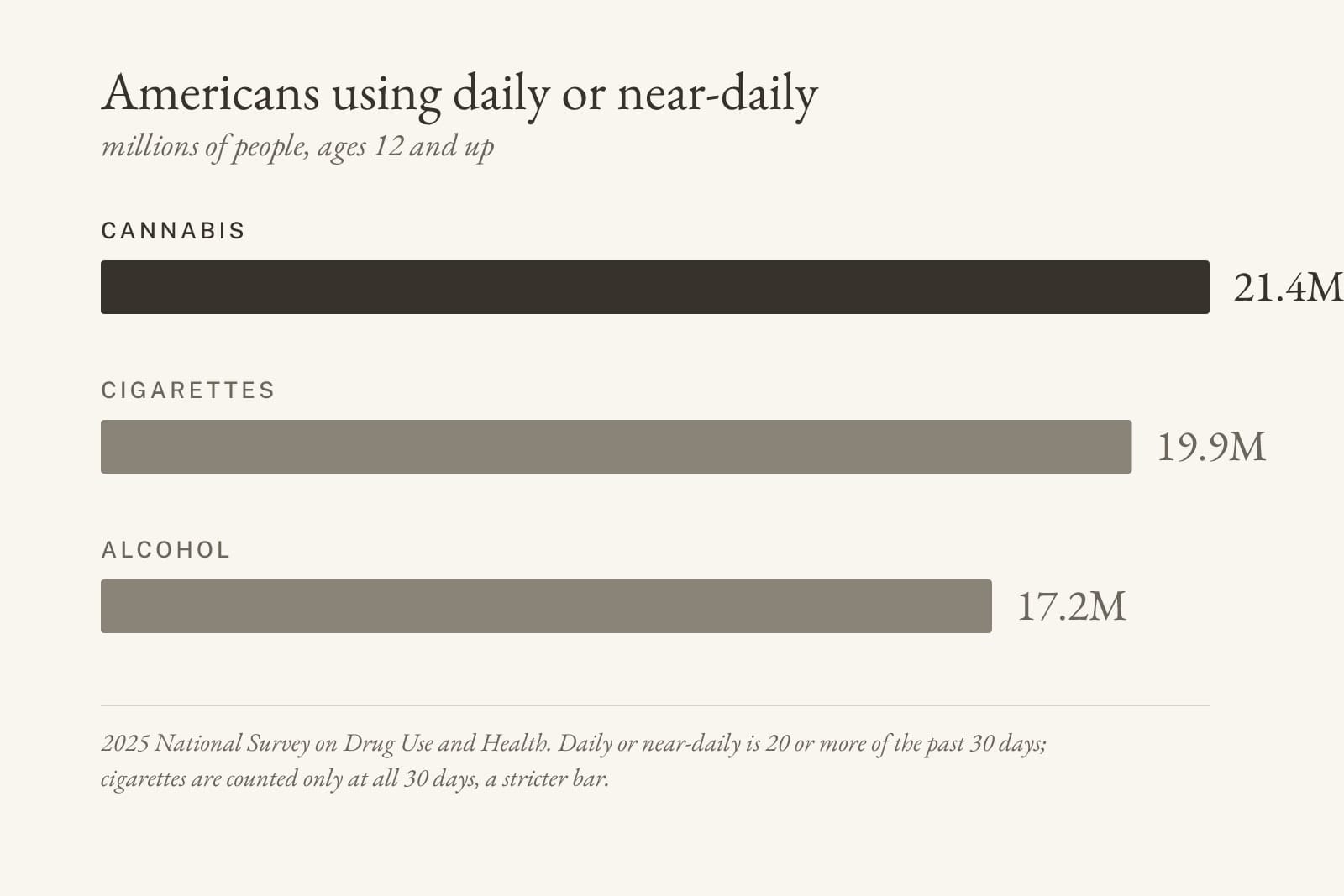
This week the federal government counted 21.4 million Americans who used cannabis on 20 or more of the past 30 days. That's more than the 17.2 million who drink alcohol that often, and more than the 19.9 million who smoke cigarettes every day. For the first time in the survey's history, cannabis is America's most popular daily drug.
I think it's undercounting. There are four markets in this country: state-legal cannabis, hemp-derived cannabinoid products, home grows, and the illicit market. Somebody buying delta-9 gummies from a hemp website isn't telling a federal surveyor they use marijuana, and someone using cannabis from their home grow isn't reporting that either.
Cannabis is deflationary
I've been building software for cannabis retailers since 2014, so I've watched this happen one receipt at a time. Back then a good eighth was $50 or $60. Today it's $25 or $30. Cannabis is one of the few deflationary products in America. Your bar tab went up. The eighth got better, safer, more tested, and costs half as much.
And the plant got more potent, while a variety of cannabinoids like CBD, CBG, THCa, and THCV continue to be discovered and combined. Flower, concentrates, vapes, low-dose beverages, more research on cannabinoids and terpenes than we've ever had. This is a plant that has been with us for centuries, carried around the world as dry sift and hash and flower genetics passed hand to hand, and we're just beginning to reclaim it.
Cannabis is medicine
People don't want to be hungover. There's a real focus now on longevity and quality of life, and this is where cannabis splits from the other two lines on that survey chart. It helps with sleep. It helps with chronic pain. Alcohol and tobacco have no real medical benefits. Cannabis is medicine, and people need real relief.
We've also been through a war on drugs that was largely racist. From Black Lives Matter to cannabis being declared essential during COVID, the country slowly recognized that this plant is not heroin, whatever Schedule I says, and that people shouldn't be incarcerated for growing and possessing it. For over fifty years cannabis sat in Schedule I next to heroin, while fentanyl and cocaine sat a rung below it in Schedule II. Fentanyl killed more than 70,000 Americans in 2023 alone. The federal government's official position was that it had more accepted medical value than cannabis.
Alcohol is linked to about 178,000 American deaths a year. Tobacco, about 480,000. Nobody has ever died of a cannabis overdose. Zero. We should say that plainly, and we should be honest about the rest too: this plant is more potent than it has ever been, and highly concentrated doses can have real adverse effects, especially for minors. And here the data is on regulation's side: teen use keeps falling as states legalize. A regulated market is how you hold both truths at once. Tested products, labeled doses, ID checks at the door. The illicit market checks nothing.
No taxes on medicine
Expect the 21.4 million number to anchor every policy fight for the next year, starting with taxes. The New York Times editorial board wants cannabis taxes raised to discourage heavy use. A federally funded study out of Ohio State found that approach backfires: roughly 89 percent of the consumption reduction from higher prices gets offset by consumers switching to illicit products. Michigan is running the experiment right now. A 24 percent wholesale tax that was supposed to fund roads brought in a third of what was projected in its first four months.
If daily use is the concern, pushing the heaviest consumers toward untested, unregulated products is the worst available response.
We don't tax medicine in this country. Walk into a pharmacy: prescriptions are exempt from sales tax in nearly every state. If cannabis is medicine, and Schedule III now says it is, taxing it at all is inconsistent. If we insist on taxing it like alcohol and tobacco, then tax it like alcohol and tobacco. The federal excise on beer is 58 cents a gallon, pennies on a six-pack. Cigarettes are the most heavily taxed product on the shelf, about three dollars a pack in federal and state excise, roughly 30 percent of the price. Washington taxes cannabis at 37 percent at the register, and after sales tax the total runs 44 to 50 percent. Higher than beer. Higher than cigarettes. That's not a sin tax, that's a gift to the illicit market. And if it's medicine, moving it to Schedule III isn't the finish line. Deschedule it.
Since 1992, daily cannabis consumption per capita has grown nearly 15 times over. No tax rate will undo that. The only policy question left is which market serves those consumers: the regulated one, or the illicit one.
Eleven years ago on that stage, people told us this was never going to happen. It was always a matter of when, not if. We'll keep pushing until this plant gets the treatment it deserves, and its benefits are accessible to everyone.